
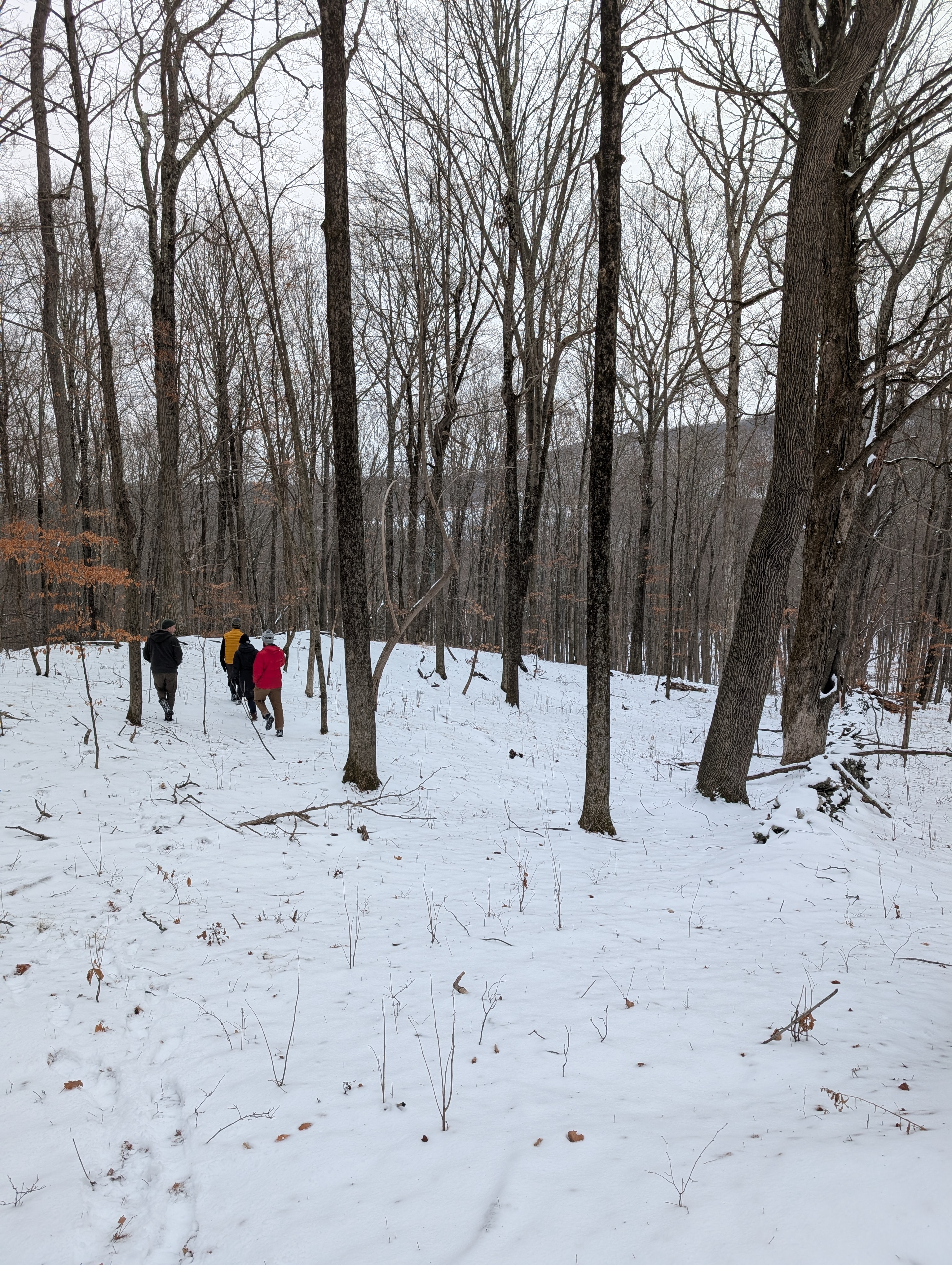
In the heart of the Hudson Valley’s sloping hills is an agroforestry project with a beautiful end goal: return to the land the plants and trees indigenous to it. Decades of invasive, endless growth have left the land with a lack of biodiversity. Slowly and surely, though, this diversity can be reintroduced. Even the pawpaw, a fruiting tree once native to upstate New York, can come back – if we make the effort.
I had the privilege last week to hike these snowy hills alongside Sachem HawkStorm, the hereditary chief of the Schaghticoke First Nation. His project – Caskoak, which translates to “a safe place,” or “land of the heron” – is vested in repairing a damaged ecosystem, but in the process of making such earthly repairs, the opportunity to repair the soul seems equally as important to him.
We walked the hills with a kind of saunter. Hawk introduced the medicinal qualities of red willow, white pine, and shagbark hickory. He showed us his tribe’s drum and played for us, asking us to listen to it as though we were hearing the heartbeat of the planet.
In the saunter, I felt torn in two. Our bodies are being filled with plastic, our waters pumped with toxic chemicals, the air we breathe polluted with emissions wreaking havoc on our communities. We have forgotten this world of our past, turned it into a commodity that demands endless profit, but if we go looking for it, we can so easily be reminded of something simple and powerful – our common roots in the dirt, the carbon we’ve borrowed to be life here, as Hawk put it, and the carbon we’ll one day give back.
I wrestled with a tough question: it’s one thing, this difficulty, of waking people up to the planetary crisis we face – something protesters and prophets can and are doing shouting from the streets that we are in a climate emergency; it’s another thing altogether to remind us that this precious life before us, our sacred Earth, does not belong to us but us to it.
At a small snow-covered stream, Hawk pointed out to us a pre-colonial stone wall – at least a thousand years old, he estimated. The walls weaved around the property like snakes, and indeed, that’s precisely what they were to those who built them in the likeness of timber rattlers. At the ends of the serpentine walls were triangular “heads” with eyes and a tongue, and unlike our walls of today – intended to keep people out and set strict boundaries – these walls served perhaps the most important function of any ancient art, to tell a story.
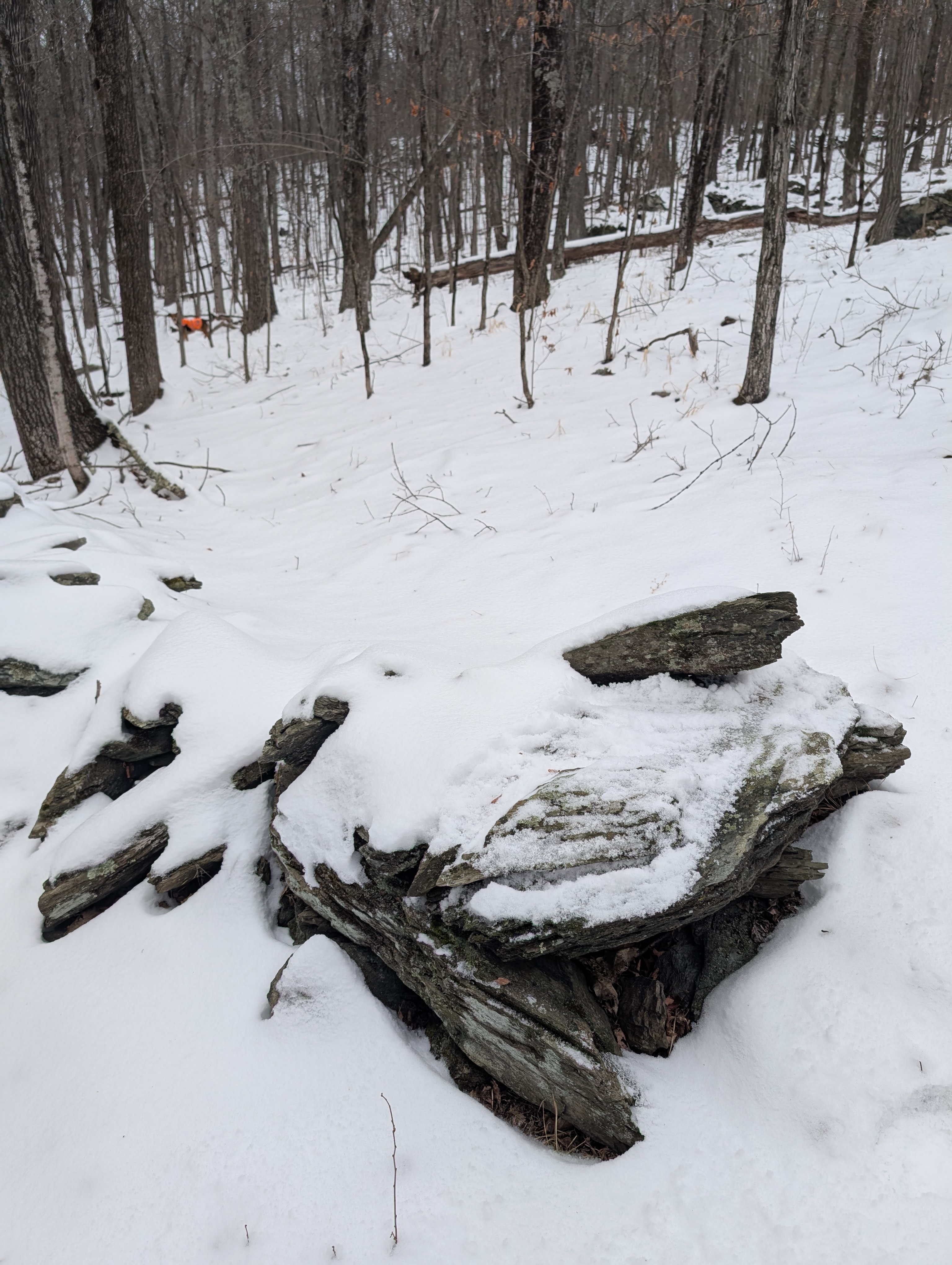
We hiked to a cairn, if I can call it that, where the wall was raised higher and seven stones – unlike the usual slate and long slabs of bedrock stacked one atop the other – were carefully placed in a line between the other stones with a kind of intentionality that signified this section of the wall as particularly sacred. Hawk asked us if we were familiar with the story of the seven fires prophecy.
At its heart, this story from the Anishinaabe is a story of forced migration – seven, in fact, all too often driven by the lies and land-grabs of light-skinned settlers. Each “fire” coincides with a prophet warning of futures where the ultimate outcome depended on whether humans would choose brother- and sisterhood, namely to coexist with the planet and each other, or whether they would choose destruction.
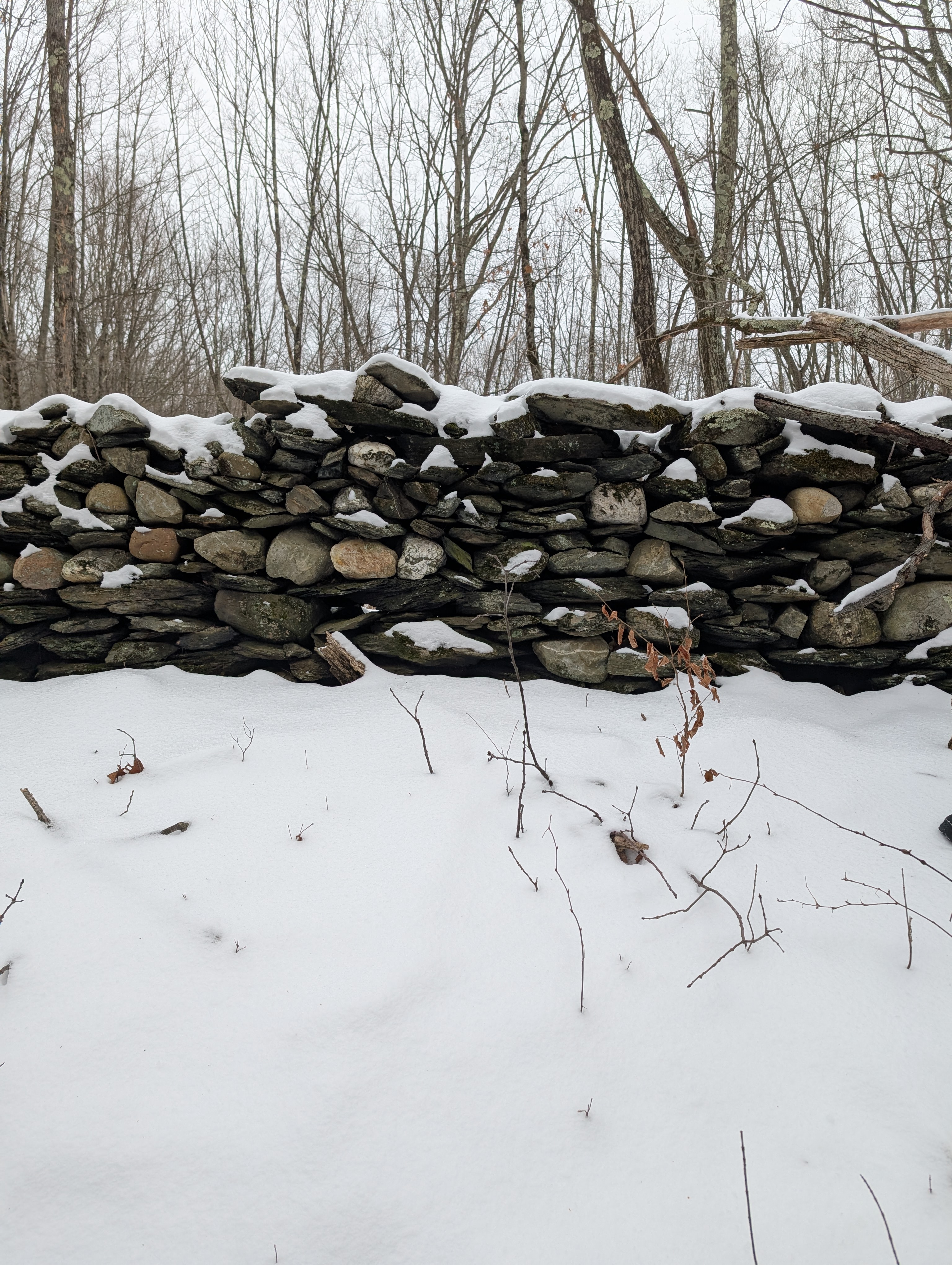
There is an eighth fire, Hawk explained, which tells of a time when the youth – no longer able to rely on adults – must turn to their ancestors for wisdom, and as the fire scorches all that surrounds us, a choice must be made: a green turning to a world where we unite and move to caring for our shared home together, or a world where we choose death outside of community. He pointed out the eighth rock. To me, it could have been a geode if cracked open, though I’m not a geologist. It also bared an eerie resemblance to a skull. I watched it with trepidation and a heaviness I haven’t known in a long time. I also filled with a sense of awe I haven’t in years.
“We have to wake people up, we have to remind them who they are,” HawkStorm shared, and I knew in that moment what a leader he is.
Growing up knowing I was adopted yet not knowing my ancestry was, in a way for me, freeing. Who I was at its heart was as wild and as open as my imagination. With inherited roots, what kinship meant to me was not restricted by blood or soil. I found love and hope in the notion that I was mere stardust and also, wonderfully stardust. I found love and hope in the notion that my family was my choice, and I theirs, and as I met so many people torn asunder by their biological roots, that point was one that was painfully and frequently underscored. To remind people who they are, to me, was not merely a question of a generation ago or fifteen generations of blood. It was a question about our belonging to one another and to this planet, and the deep responsibility that comes with that.
I have spent ample time thinking about how to wake people up – the power of the press, the power of prophets shouting from the streets, “This is a climate emergency.” But this moment is so much more than the collective crises we face as a nation, as a species. It’s a kind of spiritual awakening, as well, to something greater than us, beyond borders and walls, and to the opportunities before us to shift to a better world in search of it. No matter how dark this moment in our history may seem, no matter how ugly it may get, this is the one form of faith I do not think I will ever shed, and to have found it again there in the woods with HawkStorm pressed on me a need to share it.
As we stood beneath the storied snake wall, a perfect, light snow began to fall on the eight of us, and for a moment we stood there in the quiet woods no sounds save our breathing.
By force or by choice, from the ashes we came and to the ashes we are returning. On our way, we may yet find each other again. We may yet shed the skins of self, like a snake, living into a kind of grace we owe and are owed to one another. For my own sake, I know I have not always done my part. I had forgotten who I am, forgotten how to commune, wronged so many I loved, and disconnected too often out of my own sense of self-preservation.
But like a forest overgrown with invasive species in need of a little diversity, you and I can be reintroduced to one another, and our collective care can heal the old wounds, and this, I believe, is our one true calling.
Discover more from saunterings
Subscribe to get the latest posts sent to your email.
